- Savage Blog
- Precision Shooting Optics Guide to Help Hit Your Marks
Precision Shooting Optics Guide to Help Hit Your Marks

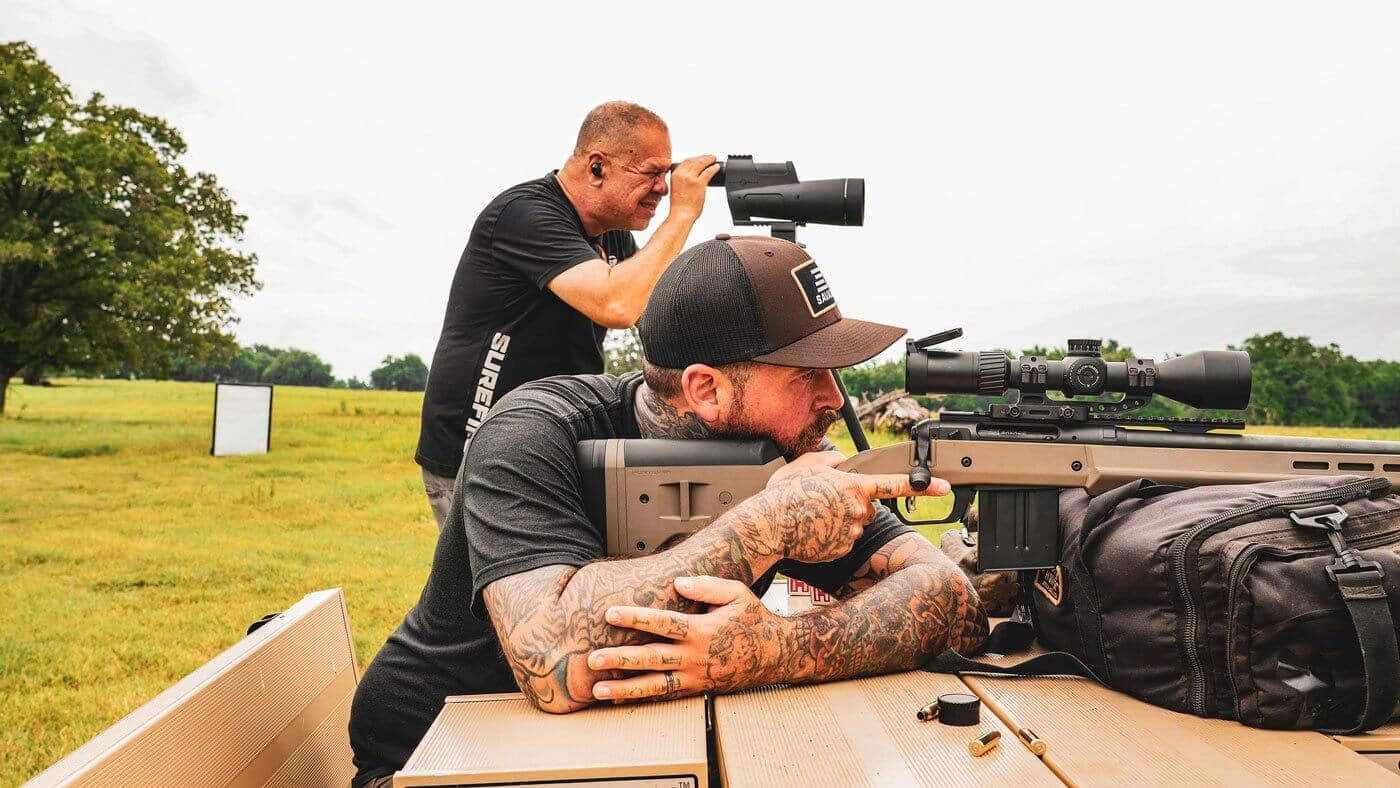
In the world of precision rifle competitions, whether PRS, NRL, outlaw matches, or club-level tactical shoots, the margin between a hit and a miss can be astonishingly small. Wind shifts, imperfect ranging, slight parallax errors, or insufficient magnification can make the difference between hitting your marks or missing the target. One of the most effective ways to close this gap is by selecting the right precision shooting optics for your rifle and your supporting kit.
We’ll break down the fundamentals of rifle scopes, binoculars, spotting scopes, and rangefinders, helping competition shooters understand what features matter most, how to evaluate them, and which upgrades will enhance consistency on the clock.
Finding the Right Rifle Scope
A good rifle scope is the backbone of your suite of precision shooting optics. Because engagements often range from 100 yards to 1,000 yards or more, your scope must provide clarity, reliable tracking, and enough magnification to see both the target and your impacts.
Magnification and Glass Quality
High magnification alone does not guarantee good performance. As magnification increases, glass quality becomes even more critical. Poor-quality lenses introduce chromatic aberration, washed-out colors, and soft edges, all of which make it harder to spot trace and see impacts.
For new shooters, a 5–25x or 4–20x is often the best balance between versatility and clarity. More specialized shooters may prefer 6–36x class scopes when shooting extreme long-range stages or rimfire PRS matches where seeing small impacts is necessary for making corrections.
First Focal Plane Advantage
Many precision shooters prefer first focal plane (FFP) over second focal plan (SFP) for a few key reasons.
- Reticles in FFP scopes will scale with magnification, meaning the reticle increases in size as the magnification increases. This allows target and competition shooters to make more precise adjustments within their reticle.
- FFP scopes use the same adjustments at all magnification levels, so a 1.5 MOA adjustment at 3x power will still be a 1.5 MOA adjustment at 10x power.
- Because of the consistent holdovers, shooters can make faster adjustments within an FFP scope.
In a competitive setting where time is limited and you may need to make corrections without touching the turrets, a first focal plane scope can provide a slight edge that can make a difference.
Critical Scope Features
Some features within a scope are non-negotiable for precision shooters.
- Zero stop – Ensures you can return to your exact zero after making adjustments to the scope. This allows you to dial corrections for different ranges and then reset back to your correct zero.
- Capped or tool-less turrets – Lower end scopes require a screwdriver, coin, or other slotted tool for making adjustments to the turrets. Capped turrets allow you to simply remove the cover and dial your adjustments, making them easier to use.
- Parallax adjustment – Keeps your target focused within your scope and allows for more precise refinement.
- Adjustable eye relief – Helpful for keeping a clear sight picture at various magnifications.
Helpful Accessories: Rings, Bases, and Throw Levers
While you can certainly get the job done with a standard scope, having a few key accessories can help bump your accuracy even further.
- Magnification throw levers – These are often easier to grasp, and control compared to the standard scope ring adjustment. If you’re making magnification changes on the fly, a throw lever can help make changes easier and more comfortable.
- Quality scope rings – Cheap rings can be less secure or have screws walk out, leading to a scope with cant or cause it to lose zero. Using solid rings at the correct height helps keep your scope secure and provides a consistent scope picture when you settle into the rifle. To find your ideal scope ring height, check out this handy calculator from EGW!
- A 20 MOA base – 20 MOA bases are preferred for longer ranges because “adds” 20 MOA of adjustment by slightly canting the scope downwards when mounted. This is especially useful for adding adjustment at extreme ranges.
Together, these accessories create a more reliable and competition-ready setup.

Best Binoculars for Precision Shooting
While binoculars aren’t always the first tool competitors think of, they can be extremely useful for stage prep, target identification, and general observation.
What Magnification Do You Need?
- 10x–12x: Ideal for field scanning and spotting at medium distances. These are easier to hold steady and great for general use.
- 15x–18x: Better for long-range observation. They are especially useful when mounted on a tripod.
Higher magnifications can show impacts better, and more environmental details, but require a rock-solid base to avoid excessive shaking and keep a stable picture of your target.
Competition vs. Practice Use
While binoculars are not commonly used directly in competition, they can be useful in a few areas:
- They’re great to grab for a quick session on the range when you may not have all of your gear.
- They can be useful if you have the opportunity to scout out your course of fire before a match, making note of environmental cues that you can use for wind calls.

Spot On Spotting Scopes
After your rifle scope, a spotting scope is arguably next in line for the most important precision shooting optics. They are commonly used to call hits, misses, and corrections for a shooter. A good spotting scope can be the difference between an effective follow up shot, and being lost in what to do next.
Core Spotting Scope Features
A good spotting scope should offer:
- High magnification – Typically 20–60x or higher for zeroing in on targets at longer ranges.
- Adjustable eye relief – Helps reduce eye strain during long periods of observation and provides a clearer picture at higher magnifications.
- Stable base or tripod mount – Stability is essential for identifying impacts on or off target.
Look for spotting scopes that come with clear glass, high magnification levels, and good parallax and eye relief adjustment. While some spotting scopes will come with a tripod, you may also choose to invest in an aftermarket tripod that provides good stability and quick adjustment for moving from target to target.

Reliable Rangefinders
Precision shooting optics should help you hit your marks easier at range. None are more important in that regard than a good rangefinder. A shooter’s ability to estimate distance quickly and accurately can make or break a stage, and rangefinders make that process easier and faster.
Key Rangefinder Considerations
- Maximum Reflective Range
Choose a device with a range capability well beyond your expected match distances. If the farthest target is at 1,100 yards, a 1,000-yard-rated rangefinder may struggle under poor lighting or limited ranging. - Angle / Slope Measurement
Rangefinders that measure for slope can help with more precise measurements at distance. In matches with steep uphill or downhill shots, angle compensation ensures your ballistic calculations remain accurate. - Integrated Rangefinding Binoculars
Some binocular models now include built-in rangefinders, a powerful combo for both hunting and competitive disciplines. If you’re looking to consolidate your gear, or have a piece of gear that’s useful in multiple scenarios, they can be handy.

Putting It All Together
Choosing the right mix of precision shooting optics goes far beyond picking a popular scope. It requires evaluating your shooting style, typical match environments, and the distances you expect to encounter. Each piece contributes to a better understanding of your shot, and together, they elevate your consistency and hit percentage.

Whether you're a seasoned competition shooter refining your kit or a newcomer stepping into the world of precision rifle matches, investing in quality precision shooting optics, and understanding how to use them, can transform your performance.
